
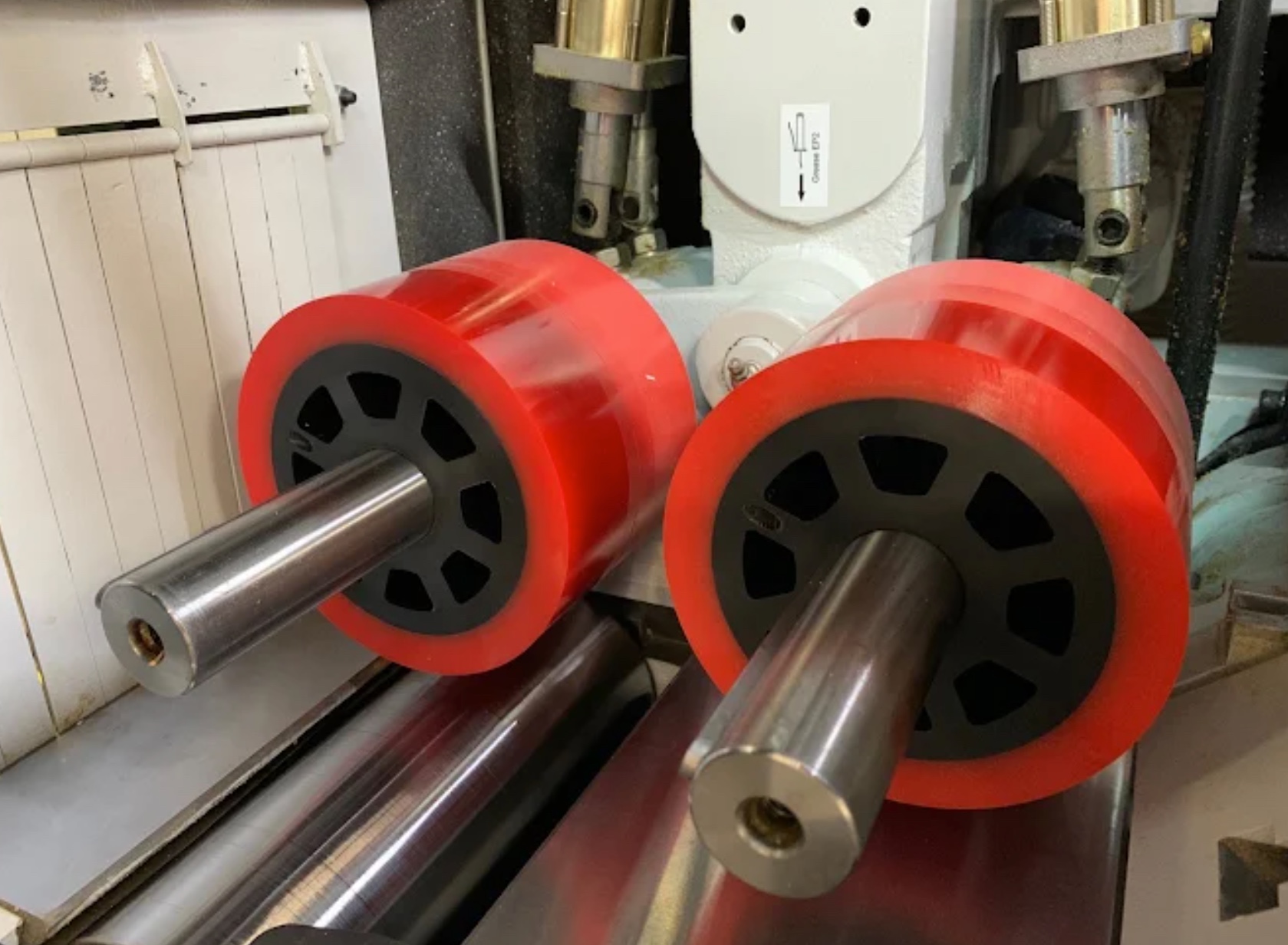
WRC's dual-duro roller system features an economical one-way design that eliminates the need to return your existing rollers for recover. 140mm diameter x 2½" wide shaft-mount rollers are now available for moulders with 35mm bores and 10mm keyways. 140mm OD x 20mm wide flange-mount rollers are also available for Weinig moulders. Available in several hardness options.
Why "one-way" matters on a moulder
The traditional way to keep feed rollers working is to send them back. You pull the worn rollers, crate them, ship them, wait while the old urethane is stripped and fresh material is cast onto your cores, then wait again while they come home. The cores are yours, so you cannot run without them — which means either the machine sits, or you carry a second set purely to cover the turnaround.
A one-way roller breaks that cycle. The urethane is cast onto a core that ships with the roller, so a replacement is a stock item rather than a service order. When the roller wears out, you fit the new one and the old one goes in the scrap bin. Nothing is crated, nothing is tracked, and nothing has to come back before the machine can run again.
That trade is not free — you are buying a core you would otherwise have reused — and on a low-volume line the recover route can still be the cheaper one on paper. What the one-way design buys you is time and certainty: no shipping in either direction, no turnaround to plan around, and no chance of a set going missing between your floor and ours.
The dual-durometer construction
Feed rollers are asked to do two things that pull against each other. They need enough grip to drive stock through the cutterhead without slipping, and enough stiffness that they do not deflect under pressure and let the stock wander. A single hardness is always a compromise between the two.
The dual-duro construction puts a harder inner layer against the core and a softer outer layer at the working surface. The inner layer carries the load and keeps the roller round under clamp pressure; the outer layer conforms to the stock and holds it. The result is a roller that grips like a soft one and holds its shape like a hard one.
It also changes how the roller wears. A single-hardness roller in a heavy feed section tends to lose diameter across its whole face at once. With a harder backing behind it, the softer surface wears more evenly and holds its profile for longer before the feed pressure has to be adjusted.
What is available now
Shaft-mount, 140mm diameter x 2½" wide. Bored 35mm with a 10mm keyway — the common shaft on moulders from Kentwood, Leadermac and others in that class. This is the workhorse size for upper and lower feed positions on four- and five-head machines.
Flange-mount, 140mm OD x 20mm wide, for Weinig. Weinig's feed sections mount on a flange rather than a keyed shaft, and the narrow 20mm face suits the stacked arrangements used on the Hydromat and Powermat series. Because these bolt on, a set can be changed without pulling a shaft.
Both are offered in several hardnesses. Softer compounds suit dry, planed stock where grip is the priority; harder compounds suit rough, wet or resinous material where the roller has to resist cutting and tearing. If you are unsure which way to go, tell us the species, the moisture content and the feed speed and we will make a recommendation — we would rather size it right the first time than sell you a set that disappoints.
Fitting them to your machine
Feed rollers are one of the few parts on a moulder where a small dimensional error is expensive. A bore that is 35mm nominal may be 35.02mm on a machine that has been rebuilt, and a keyway cut to a different standard will not seat. Before ordering, check three things on the roller you are replacing: the bore, the keyway width, and the outside diameter across the face. Measure the OD at the middle of the roller rather than the edge — the edges wear first, and a reading taken there will make a worn roller look smaller than it was new.
If your machine has been retrofitted, or if you have mixed rollers from more than one supplier over the years, send us photographs and the measurements and we will identify what you have. We keep the cross-references for most of the moulder brands in this market, and where we do not have a match on file we can work from the part in hand.
Where this fits in the range
The dual-duro system sits alongside our existing Super Drive line rather than replacing it. Super Drive remains the answer where you want a replaceable tire on a reusable steel hub, and where the tire is the only part that wears. The one-way rollers are for shops that would rather hold a stock item on the shelf than manage a recover cycle — and for machines where the core is not economical to keep.
Between the two, most moulder feed sections in this market can be covered from stock. Tell us the machine, the position and the bore, and we will tell you which of the two makes more sense for the way you run.
More news
- Western Roller launches new web storefront 25 August 2026
- Quality Super Feed rollers 29 April 2020
- A one-stop shop for replacement rollers 29 April 2020